

HombreOilsRare perfumery, preserved

The recordsAll botanicals

Station 1 of 13 · Origin · the record

Chrysopogon zizanioides (L.) Roberty

Chrysopogon zizanioides, vetiver, is a perennial grass of the family Poaceae, native to India and now grown throughout the tropics. The oil is distilled from its dried roots.

It was long called Vetiveria zizanioides; the name on record now is Chrysopogon zizanioides (L.) Roberty.

In your room

A model you can turn here or place in your room with a phone. Nothing is fetched until you ask; nothing is stored or sent. Everything you can place in a room.

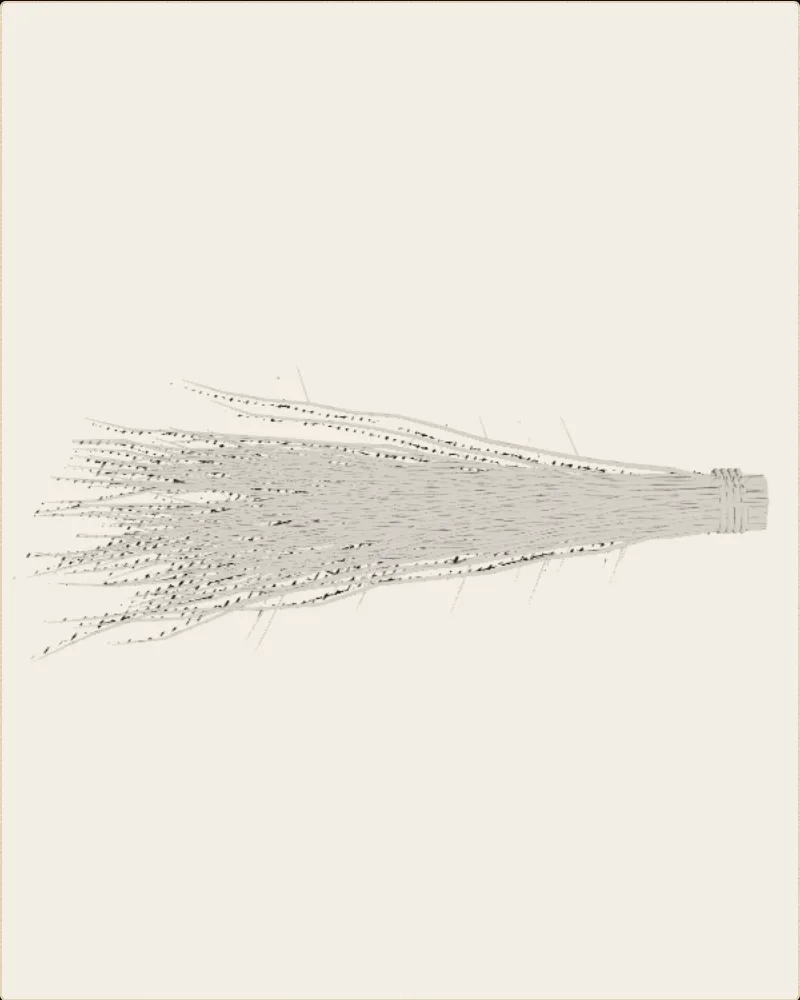
An engraved still of the model: a tied bundle of dried vetiver roots, drawn in hatched lines on parchment.

fragrance material

Vetiver roots, a tied bundle

A tied bundle of dried vetiver roots, the house’s own model. Modelled in-house (procedural, in Blender); its size is typical of the material, not a measurement; not a photograph or a scan.

To place it in your room, open this page on an iPhone or iPad (AR Quick Look) or an Android phone (Google Scene Viewer). The files below open in any 3D viewer.

A bundle of dried vetiver roots (Chrysopogon zizanioides), tied with jute: the fine, wiry, tangled roots of a tall grass, with their side rootlets, dug, washed and dried before they are distilled for vetiver oil. Modelled in-house; real bundles hold many more, finer roots than a phone model can carry.

In the room
about 24 cm long, 12 cm wide, 2 cm high. Modelled, not measured: a typical size
Source
HombreOils, in-house: modelled, textured and baked in Blender from the forms of the specimen shelf on the Materials page
Licence
in-house
Model
18,144 triangles

The files GLB 1.5 MB · USDZ 2.6 MB

The record

Each field carries its evidence: open a chip for the source, the quoted words and the confidence. A field with nothing behind it says so and stays empty.

Latin name
Chrysopogon zizanioides (L.) Roberty
documented

Chrysopogon zizanioides (L.) Roberty

GBIF-1 · GBIF Secretariat (2023) · read 2026-09-30

the GBIF record’s scientific name; the accepted name in the GBIF Backbone (usage 5677150); GC-11 and GC-12 write it the same way

confidence A

Common name
vetiver
documented

Commonly known as vetiver, this species is a member of the Poaceae family and is originally native to India and Southeast Asia but is now globally distributed in tropical and subtropical regions [1].

GC-10 · Barcellos-Silva et al. (2025). Vetiver, Vetiveria zizanioides (L.) Nash: Biotechnology, Biorefineries, and the Production of Volatile Phytochemicals · read 2026-09-30

confidence A

Family
Poaceae
documented

Poaceae

GBIF-1 · GBIF Secretariat (2023) · read 2026-09-30

the GBIF record’s family; and GC-10, GC-12: “a member of the Poaceae family”

confidence A

Part used
the roots, dried
documented

The essential oil of vetiver is obtained in 0.2–0.3 % yield by hydrodistillation of the dried roots of the tufted perennial grass Chrysopogon zizanioides (L.) Roberty.

GC-11 · Ouyang et al. (2021). The Smelling Principle of Vetiver Oil, Unveiled by Chemical Synthesis · read 2026-09-30

confidence A

Cultivars
not on record
not on record

no cultivar is named in a filed source; GC-12 distinguishes a fertile Indian form and a sterile form grown elsewhere (not quoted, not cultivars)

Wikidata
Q378568
documented

P225 taxon name: Chrysopogon zizanioides

WD-1 · Wikidata (Wikimedia Foundation) · read 2026-09-30

the item’s taxon name (P225) is “Chrysopogon zizanioides”, the record’s botanical name without its author

confidence A

Origins on record
  • Haiti
    documented

    the world’s first exporter (a sentence cited to a news article)

    confidence B

Materials

Films and plates

  • SPEC-5 · vetiver: the /materials specimen still · still
  • OR-5 · vetiver: the origin film (the field to the bench) · queued: the master queue lists OR-5 as queued (the render queue’s list, read 2026-09-30); no path until it is rendered and published
    a render-time texture (Rocky Trail 02; a render input only): "Rocky Trail 02", Amal Kumar (Poly Haven), CC0 1.0

Sources

  1. GBIF-1 · GBIF Secretariat (2023). GBIF Backbone Taxonomy. Checklist dataset https://doi.org/10.15468/39omei accessed via GBIF.org on 2026-09-30. doi.org/10.15468/39omei · read 2026-09-30 · CC BY 4.0
  2. GC-10 · Barcellos-Silva IGC, Dos Santos FKF, Kharkwal H, Chander S, Kharkwal AC, Awasthi R, Dhiman N, Sharma B, Kulkarni GT, Larssen H, Silva JML, Souza MA, Setzer WN, Veiga-Junior VF. Vetiver, Vetiveria zizanioides (L.) Nash: Biotechnology, Biorefineries, and the Production of Volatile Phytochemicals. Plants (Basel) 2025;14(10):1435. DOI 10.3390/plants14101435. PMID 40431000. PMCID PMC12114718. doi.org/10.3390/plants14101435 · read 2026-09-30 · CC BY 4.0
  3. GC-11 · Ouyang J, Bae H, Jordi S, Dao QM, Dossenbach S, Dehn S, Lingnau JB, Kanta De C, Kraft P, List B. The Smelling Principle of Vetiver Oil, Unveiled by Chemical Synthesis. Angewandte Chemie International Edition 2021;60(11):5666–5672. DOI 10.1002/anie.202014609. PMID 33315304. PMCID PMC7986879. doi.org/10.1002/anie.202014609 · read 2026-09-30 · CC BY 4.0
  4. GC-12 · Burger P, Landreau A, Watson M, Janci L, Cassisa V, Kempf M, Azoulay S, Fernandez X. Vetiver Essential Oil in Cosmetics: What Is New? Medicines (Basel) 2017;4(2):41. DOI 10.3390/medicines4020041. PMID 28930256. PMCID PMC5590077. doi.org/10.3390/medicines4020041 · read 2026-09-30 · CC BY 4.0
  5. WD-1 · Wikidata (Wikimedia Foundation): the items named on each record (each statement read with its references), read 2026-09-30. www.wikidata.org · read 2026-09-30 · CC0 1.0

Our text and structure are CC BY 4.0; quoted source text stays under its owners’ terms.

this record as data: /data/botanical/chrysopogon-zizanioides.json · version 3 · updated 2026-10-01 · confidence A